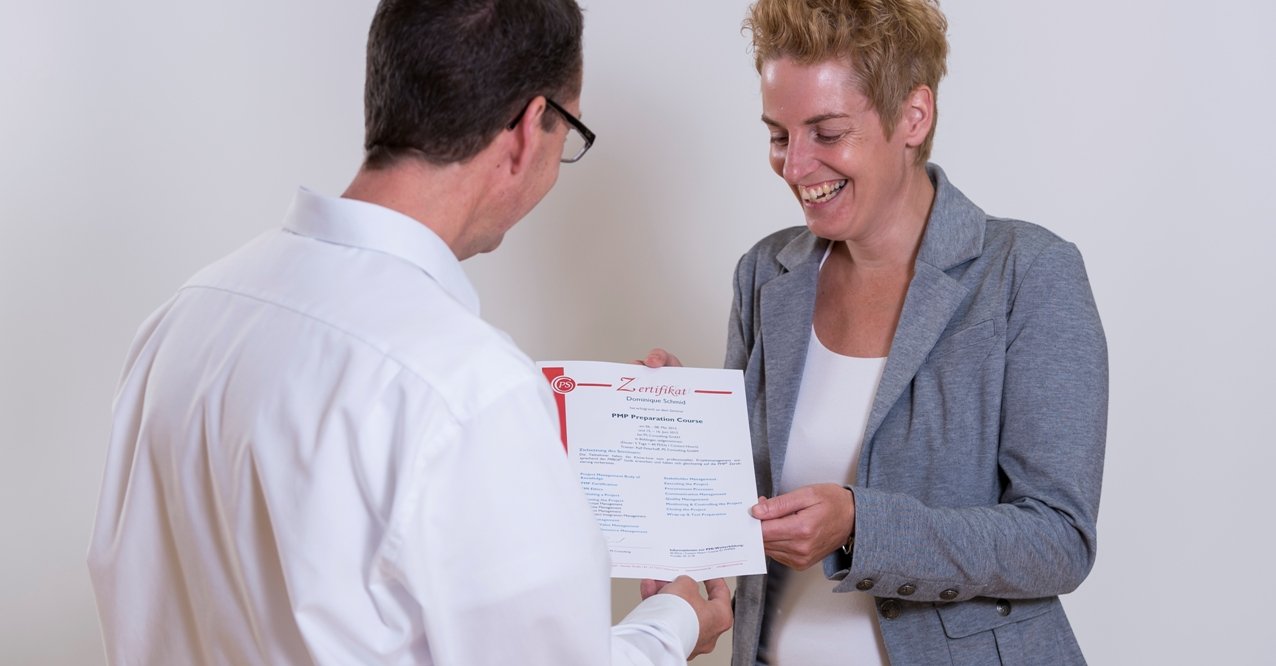
Get a real head start – with demonstrable skills in certified project management.
Whether PMP®, CAPM®, Scrum Master or Product Owner – with a recognized certification you will stand out from other project managers and open up new career opportunities.
Projects often mean great responsibility, budget and strategic importance. But how do clients, customers or your management know that you have the necessary know-how to lead complex projects to success? More and more companies are therefore relying on recognized certificates as objective proof of your project management expertise.
A certification is much more than just a title. It confirms your ability to plan, manage and successfully implement projects professionally – regardless of industry or method.
Whether you are certified according to international standards (PMI®), agile frameworks (Scrum.org) or classic models (GPM/IPMA, PRINCE2®): You prove that you take responsibility – and are ready to lead projects to success.
From choosing the right certificate to successfully passing the exam , we will guide you step by step.
Depending on your experience, knowledge and goals, you will find the right certification for you.
Our experienced trainers and the all-round carefree package take care of everything organizational – so that you can concentrate fully on learning.
This keeps you on the ball professionally, strengthens your position in the company and opens up new career opportunities for you.
Our seminars optimally prepare you for internationally recognized project management certificates – from PMI® (PMP®, CAPM®) to Scrum Master, Scrum Product Owner to GPM/IPMA or PRINCE2®. All training courses are practical, interactive and available either online or on site.
The Project Management Institute (PMI) is the world’s largest professional association in project management.
With PMI certificates, the focus is clearly on defined processes. These apply to every project, regardless of whether it takes place in Asia, Europe or America, whether it is in the chemical industry or an Olympic Games. A project is not seen as hermetically sealed within itself, but rather in relation to the environment, from the supplier to the employees to the shareholders of a company. PMI enables project staff to break down an unknown project into individual processes and areas of knowledge that everyone is familiar with and that are part of every project, from schedule management and cost management to risk management and resource planning. This takes away the fear of the unknown and makes it easier to get started. The focus is always on the process and the practical knowledge that an employee needs to be able to carry it out.

Scrum.org was created by Ken Schwaber, one of the co-founders of Scrum, and stands for the highest quality and practical relevance in the agile world.
Scrum.org certificates focus on application – not memorization. The exams are based on the official Scrum Guide and test your real understanding of roles, values and principles.
Whether Scrum Master, Product Owner or Developer – each certificate shows that you not only know Scrum, but can also use it successfully in complex projects. The certificates are recognized worldwide and send a strong signal for agile thinking and professional action.

The International Project Management Association (IPMA) is a project management association based in Europe. Its national representative is the GPM Deutsche Gesellschaft für Projektmanagement e. V.
The GPM/IPMA standard is intended to enable a more individualized approach to projects by not defining a fixed process model, but instead placing the decision for a suitable approach in the competence of the project management. It is assumed that there are national differences as well as industry-specific procedures in projects and that companies can generate a competitive advantage from this by developing individual procedures.
With GPM/IPMA, project managers should be able to think their way into a situation on the basis of their theoretical skills and an analysis of the environment and stakeholders and decide on a course of action. Soft skills such as self-management, leadership skills, communication, negotiation and conflict management play an important role. Actual practical implementation is at the forefront of the certification process. Practical experience must be described (depending on the level), reflected on and demonstrated by means of a project report, written examination and interview.

PRINCE2® is a process model of the Office of Government Commerce (OGC) and stands for “Projects in Controlled Environment”.
PRINCE 2 originally comes from the UK, but has now established itself in Europe.
PRINCE2 is a process-based method for effective project management that is now established in Europe and equips project managers with all the basic knowledge they need to be successful in project management. PRINCE stands for “PRojects IN Controlled Environments” and is recognized worldwide and predominantly used in the IT sector.
Ilona Schroth, our certification expert
Let me advise you individually and free of charge.
Please contact me!